The short answer
Your first Pilates session at Life by Pilates in Old Tappan, NJ is the Individual Assessment: 50 minutes, one-on-one, $80. We talk about your body, your history and what you’d like to achieve. I watch how you move. Then we do a real class on the Reformer and the other classical apparatus. No experience needed, and no pressure. Just a place to start.
Starting somewhere new can feel a little intimidating.
Especially when the room is full of equipment you’ve never seen before: springs, straps, leather, wood and steel.
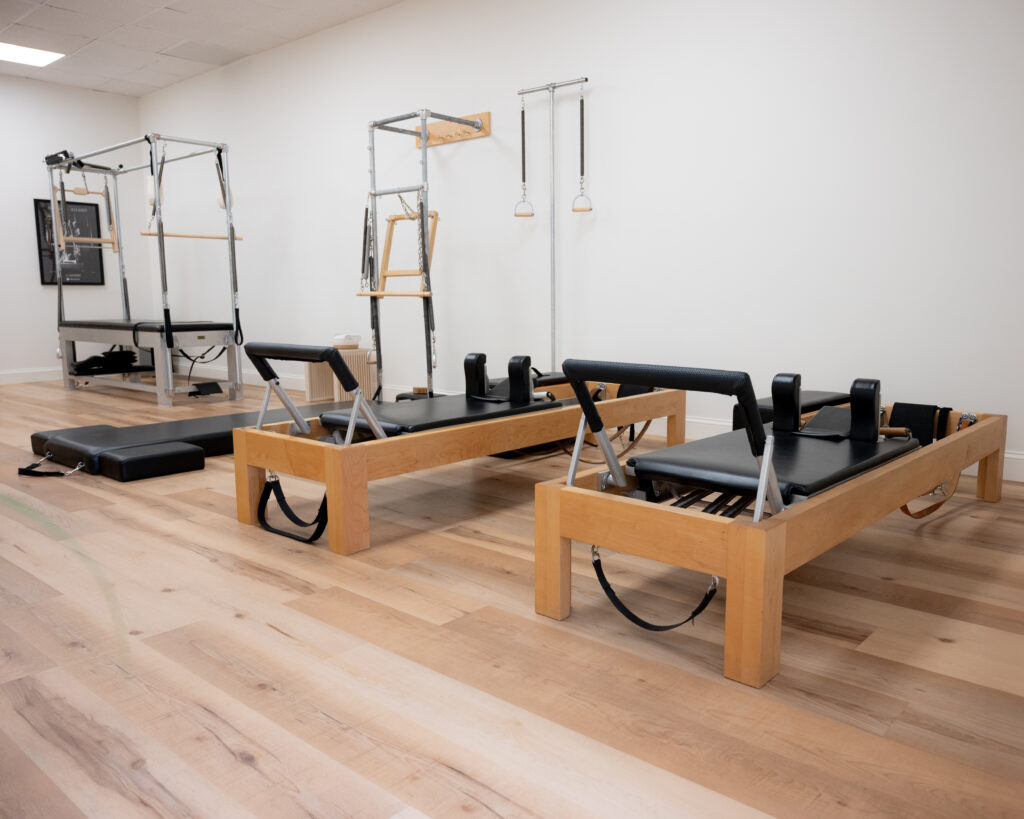
Almost everyone who comes in for the first time tells me one of two things. “I’ve never been on these machines.” Or, “I have a bad back and I’m worried about hurting it.”
Both are completely fine. Your first session is all about you: getting to know your body, your history and what you’d like to achieve, then building from there. So let me walk you through exactly what happens.
At Life by Pilates I teach true Classical Pilates, in the lineage of Joseph Pilates and Romana Kryzanowska, in private and duet sessions only. There’s no crowd to keep up with and no choreography to memorize.
What happens in your first Pilates session?
We talk first
Before you get on any equipment, we sit and talk for a few minutes.
What brought you in? A stiff back from sitting all day, scoliosis, a disc, osteopenia, a new baby, a golf swing that hurts? I ask about surgeries, old injuries and what your days look like. That tells me which movements will feel good for you and which ones we leave for later.
I watch how you move
There’s no standing against a grid. I watch how your body organizes itself once we start moving.
- Do your shoulders creep up toward your ears when you breathe?
- Does one side of your pelvis sit higher, or turn forward?
- Do your knees roll in or out when you bend them?
- Which parts of your spine move freely, and which move as one block?
That’s where your program starts.
Footwork on the Reformer
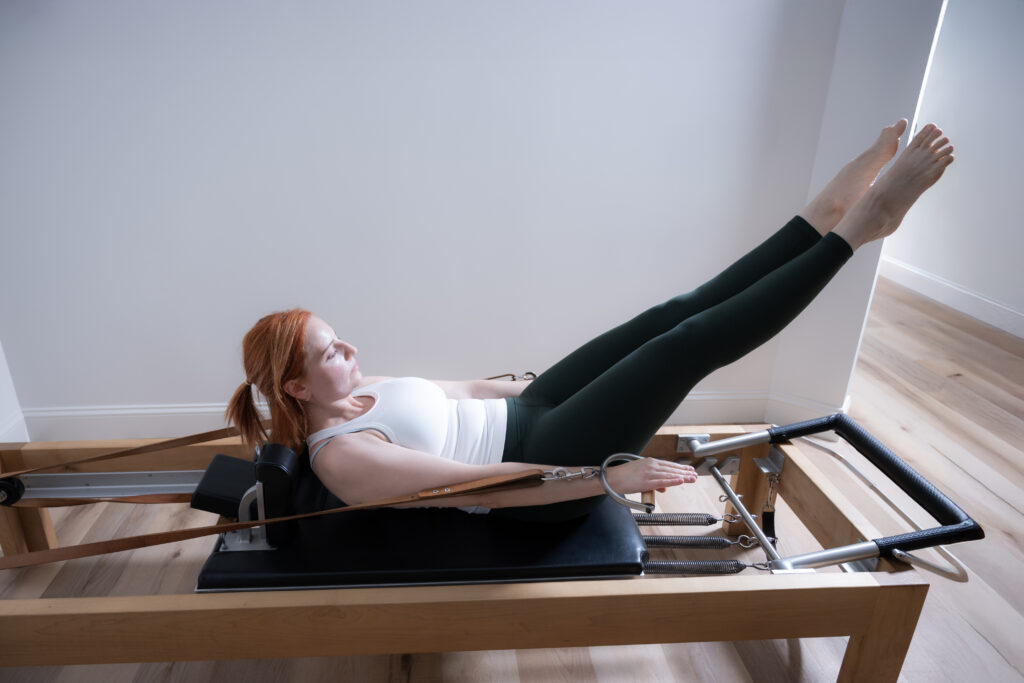
Most people start lying on the Reformer with Footwork. Your back is supported on the carriage, and you press out and come back in against the springs with your feet in a few different positions on the bar.
It looks simple. It teaches three things you’ll use in every exercise after it:
- Keeping the pelvis quiet while the legs move.
- Controlling the springs on the way back, instead of letting the carriage pull you in.
- Breathing while you work.
One or two more pieces of apparatus
Depending on what I see, we may go to the Cadillac, where the springs support you so a stiff back can roll down one part at a time. Or to the Wunda Chair or the Mat, to see how you sit tall without gripping in your neck or hips.
We make a plan
By the end of the 50 minutes we both know where you’re strong, where you compensate and what we’ll work on next.
You shouldn’t leave exhausted. Most people tell me they feel taller.
Why is the first session one-on-one?
In a big class, or with an app at home, most people use the muscles they already overuse: the neck, the hip flexors, the lower back. Learning to work from the Powerhouse, the deep muscles around your middle, takes someone watching.
There’s research behind this. In 2008, I. Endleman and D.J. Critchley used ultrasound to look at the deep abdominal muscles of 26 experienced Pilates practitioners during classical exercises (Endleman I, Critchley DJ. Archives of Physical Medicine and Rehabilitation, 2008; PMID: 18996251).
The transversus abdominis and internal oblique worked during the exercises they tested. But when the imprint was done without drawing the belly in, neither muscle worked more than at rest. And the Hundred on the Reformer worked the transversus abdominis harder than the same exercise on the mat.
So the same exercise, done a little differently, uses different muscles. That’s why I watch and cue every repetition, especially at the beginning.
What should I wear and bring?
- Comfortable clothes that fit close to the body, so I can see your spine, hips and knees. No zippers or buckles on the back, because they catch on the leather.
- Socks. Grip socks are best, for hygiene and so your feet don’t slip on the bar.
- Come about five minutes early to take your shoes off and settle in.
- A light snack an hour or two before is fine. A big meal right before isn’t, because we’ll be working your abdominals.
Check with your doctor first if…
You’ve had recent surgery, you’re pregnant or recently gave birth, or you’ve been diagnosed with a spinal condition like a herniated disc, stenosis or osteoporosis. Get clearance first and tell me about any restrictions when we start. Every session is private or duet, so I can adapt the work to what your doctor says.
How do I book my first session in Old Tappan?
The Individual Assessment is $80. It’s recommended before your first class and required before a monthly membership. If you’d like to start together with a partner or a friend, there’s a duet assessment too, at $50 each. Everything is on the rates page.
Whenever you’re ready, reach out through the contact page or call (201) 846-0131. I’m happy to help you find the right starting point.
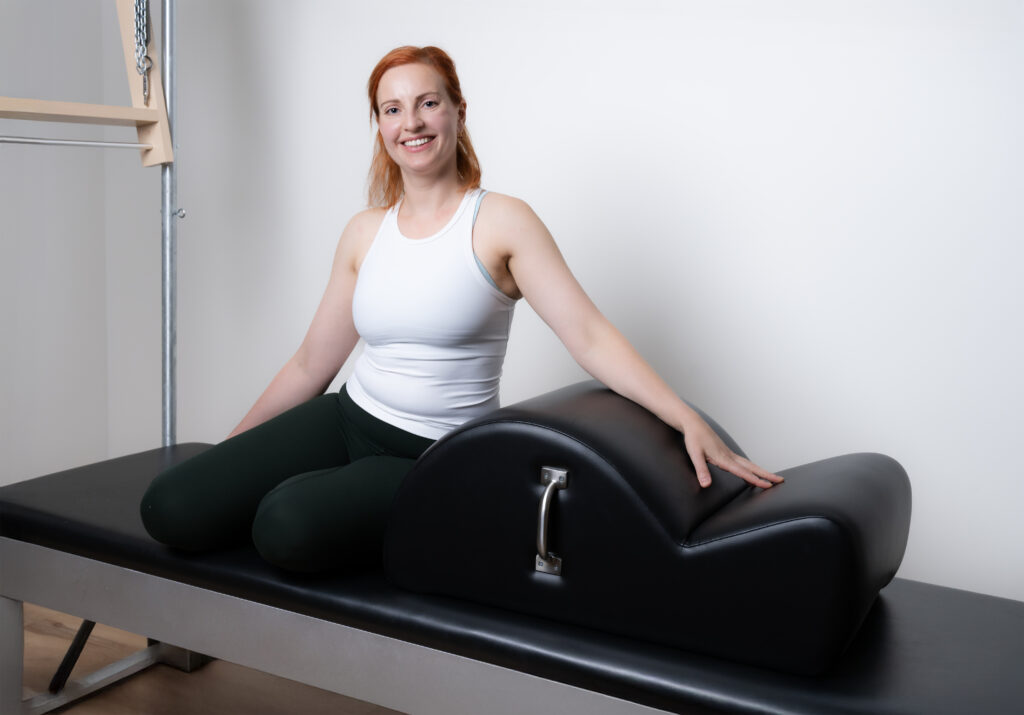
Katya Almog is a Romana’s Pilates-certified Classical Pilates teacher and the owner of Life by Pilates, a private studio at 216 Old Tappan Rd, Old Tappan, NJ.
Frequently asked questions
No. Waiting until you’re flexible to start Pilates is like waiting for your back to stop hurting before you see someone about it. The springs support you, so we start exactly where you are.
Maybe a little, in places you don’t usually feel: the deep abdominals, the inner thighs, the middle of the back. It shouldn’t be painful. In a first session I care about how you move, not about tiring you out.
You can start together with the duet assessment. If one of you has an injury or a very specific goal, a private first session is worth it, so I can look at that properly.
Many people feel a difference in their posture and their lower back as soon as they walk out of the first session. Lasting change comes with coming regularly: after several weeks the movements stop feeling new, and you start noticing how you sit and stand outside the studio.
Coming regularly matters more than working hard. Once or twice a week on a steady schedule, so each session builds on the last one.