The short answer
Postpartum Pilates should start gently, and only after your doctor or midwife clears you. At Life by Pilates in Old Tappan, NJ, I begin with the breath, the pelvic floor and the deepest abdominal layer, with your back supported on the Reformer or the Cadillac, and build from there at the pace your body and your doctor allow. Being cleared to exercise and having a strong center again are two different things. The work in between is what this post is about.
For nine months, someone checks on you all the time.
Then, around six weeks after the birth, you have one appointment and hear “you’re cleared for exercise.”
Cleared to move isn’t the same as resuming fitness activity. You can’t simply jump back to where you left off.
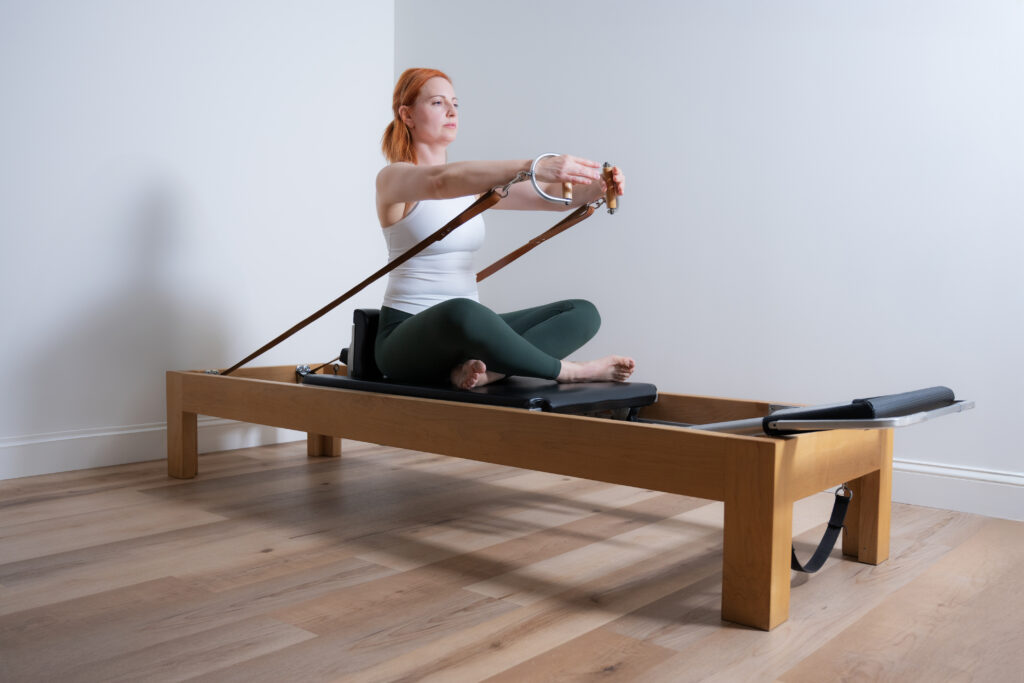
At my studio in Old Tappan, I work one-on-one with mothers at different stages after birth. We practice Classical Pilates, and we start with the breath and proper core activation and engagement. We take time to rebuild a strong foundation.
What happens to the core during pregnancy?
Think of your deep core as a cylinder, the center Joseph Pilates called the Powerhouse:
- The top is the diaphragm, your breathing muscle.
- The bottom is the pelvic floor.
- The front and sides are the transversus abdominis, the deepest abdominal layer. It wraps around you like a corset and meets in the middle at a band of connective tissue called the linea alba.
- The back is the small multifidus muscles along the spine.
During pregnancy the linea alba stretches for months, while the pelvic floor carries more and more weight. After the birth, that doesn’t go back overnight.
If you go straight to sit-ups, planks or heavy leg lowers before the deep layer and the pelvic floor work together again, the pressure inside pushes out against the stretched midline and down on the pelvic floor. That’s why I start much smaller than that.
What does the research say about postpartum Pilates?
In 2023, N. Lee and colleagues followed 35 first-time mothers after birth (Lee N, et al. BMC Womens Health, 2023; PMID: 38008749). Twenty did Pilates for 50 minutes a day, five days a week, for four weeks. Fifteen kept their usual routine.
The researchers used ultrasound to measure the gap between the two sides of the abdominal wall (the inter-recti distance) in three places, along with waist size and abdominal endurance. Compared with the other group, the Pilates group ended up with a smaller gap, a smaller waist and better endurance. The authors wrote:
“The results of this study demonstrate that Pilates was effective in reducing inter-recti distance and waist circumference and improving abdominal muscle endurance in primiparous postpartum women.”
Those women exercised more often than most new mothers can, but it’s an encouraging result.
On the pelvic floor, most of the research looks at Pilates during pregnancy rather than after it. In 2024, G. Buran and S. Erim Avcı randomly assigned 126 women expecting their first baby either to Pilates-based birth preparation, twice a week for eight weeks starting at 28 to 30 weeks, or to routine care (Buran G, Erim Avcı S. Arch Gynecol Obstet, 2024; PMID: 39083052). The Pilates group had less severe stress and urge leakage after the program and in the early weeks after birth.
If you have any leakage after birth, a pelvic floor physical therapist is a great first stop, and I’m happy to work alongside them.
How does postpartum Pilates progress?
Every birth is different, and recovery after a C-section follows its own timeline. These are the stages I usually work through once your doctor or midwife has cleared you.
The first weeks: rest and breathing at home
The first weeks are for healing, for sleep, if you get any :), and for your baby.
If your doctor agrees, short walks when they feel good and gentle breathing are enough. Breathe into the sides and back of your ribs. As you breathe out, feel the pelvic floor and lower belly lift a little. No straining.
After clearance: finding the deep muscles again
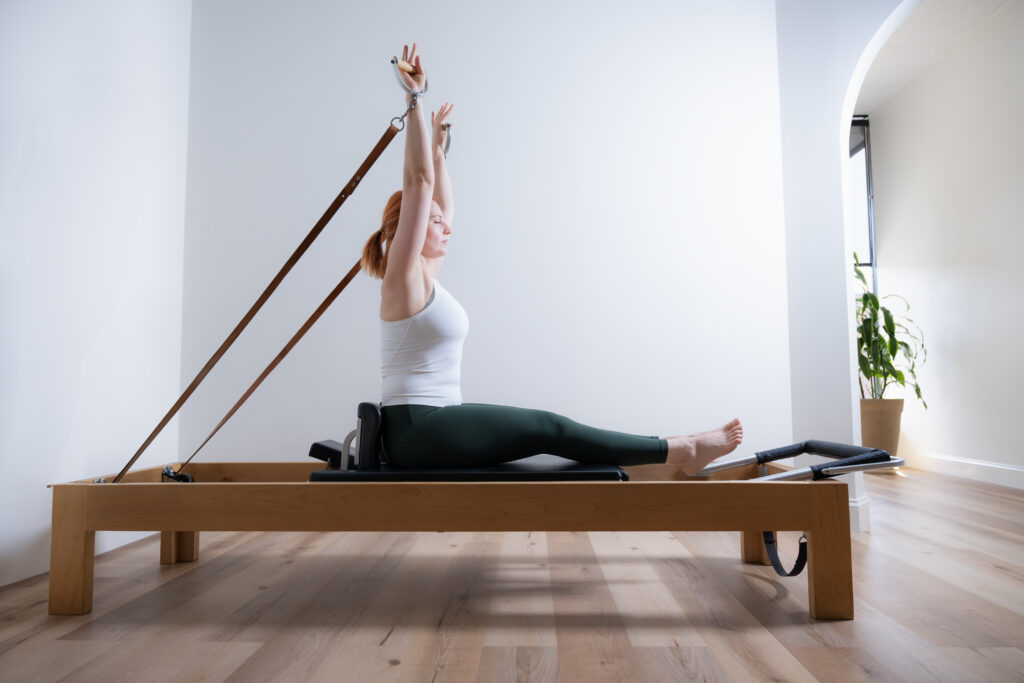
The first goal in the studio is to feel the deep muscles again, not to burn calories. With your back supported on the Cadillac or the Reformer:
- You start each movement with the breath out and the belly drawing in, so it flattens instead of doming.
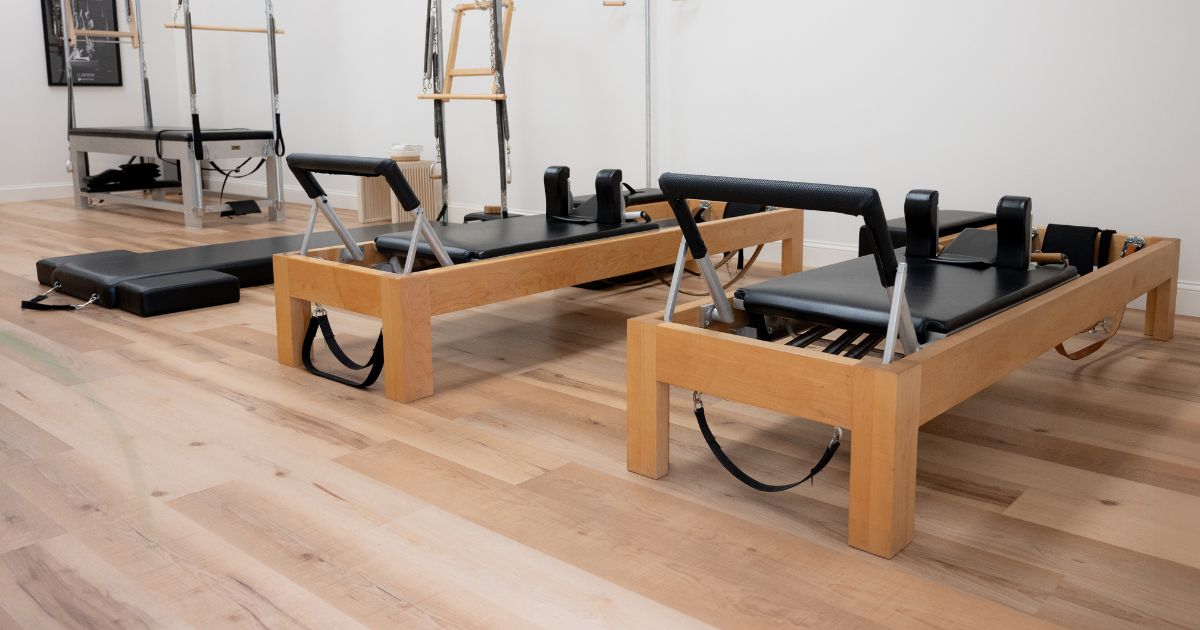
- Footwork on the Reformer, with light springs, works the legs, hips and pelvic floor while your back rests on the carriage.
- We open the chest and upper back on the Cadillac, because feeding and carrying a baby pull your shoulders forward all day. Many mothers feel immediate relief in their shoulders and neck.
When the middle holds: more stability
When your abdominal wall stays flat while you work, we add more:
- One leg at a time with the leg springs on the Cadillac, and sitting work on the Wunda Chair, for a steady pelvis.
- Rolling through the spine with the springs helping, without heavy forward bending while a gap is still closing.
- Strength in the upper back and glutes, so you lift the car seat with your legs and not your lower back.
Later: the full classical work
When your midline feels firm and your pelvic floor handles effort without heaviness or leakage, we bring back the rest of the Classical Pilates repertoire on every piece of apparatus.
And if your youngest is already in school, it isn’t too late to start. The body responds at any stage.
Please see your doctor or a pelvic floor physical therapist if…
You feel heaviness or bulging in the vagina, you have ongoing urine or bowel leakage, a C-section scar is red or oozing, bleeding gets worse with activity, or the middle of your belly domes sharply when you move. Always get clearance from your OB-GYN or midwife before you start postpartum Pilates. I’m glad to coordinate with your doctor or therapist so every exercise stays within what’s safe for you.
Postpartum Pilates in Old Tappan
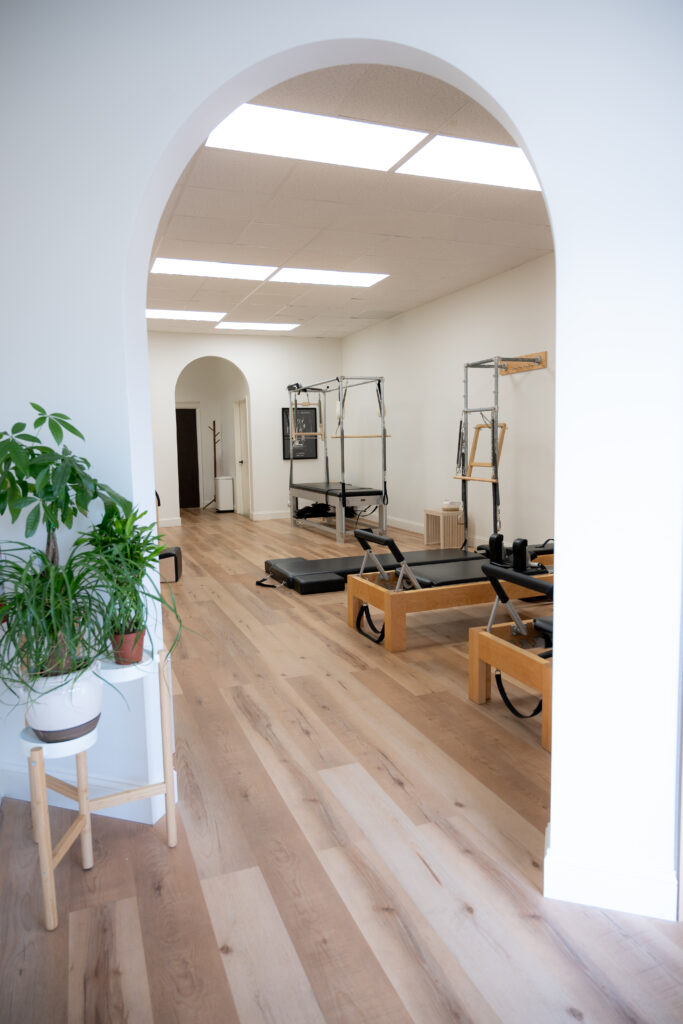
This isn’t about bouncing back by a deadline. It’s about feeling strong and comfortable in your own body again, so you can carry, lift and play with your kids without your back or your pelvic floor complaining.
If you’re looking for private postpartum Pilates in Bergen or Rockland County, you’ll find the options on the rates page. Whenever you’re ready, reach out through the contact page.
Katya Almog is a Romana’s Pilates-certified Classical Pilates teacher and the owner of Life by Pilates, a private studio at 216 Old Tappan Rd, Old Tappan, NJ.
Frequently asked questions
When your OB-GYN or midwife clears you. For many women that’s around six weeks after a vaginal birth, and often later after a C-section or a complicated delivery. Your doctor’s timeline comes first.
It can be, when the exercises are adapted. Some classical exercises, like the Hundred with the head up and the legs low, the Roll-Up or Double Leg Stretch, push out on a stretched midline. In a private session I change the head position, the angle of the legs and the spring support, and I watch your belly on every repetition so it stays flat instead of doming. If your gap is wide, I’d also like you to see a pelvic floor physical therapist.
Yes. A C-section is surgery through several layers of the abdominal wall. Even when the scar has healed on the surface, the area can feel numb or tight, and the lower belly can be hard to feel at first. We start with the legs, hips and upper back and bring the abdominal work in slowly as you heal.
Yes. While you’re breastfeeding, your joints and ligaments, especially around the pelvis and lower back, can stay looser than usual. So I keep stretches moderate and focus on control around the hips and pelvis. Feeding is also one more reason we work on the upper back and chest.
Because every recovery is different. One mother has a wide gap and tight shoulders. Another has pelvic pain or a tight scar. In a private session I can watch your breathing and your midline the whole time and change the exercise the moment something isn’t right.