If you’ve been living with chronic back pain, you’ve almost certainly been told to “try Pilates.” Friends say it. Doctors say it. Physical therapists say it. But few of them can tell you what the research actually shows — or how a personal, dedicated Pilates session in a private classical studio differs from the 12-person reformer classes at large chain studios.
This post answers both questions.
The short answer
Yes, Pilates helps with chronic back pain. The research is clear and so is my experience with the clients who walk through my door. Here is what you need to know in three sentences:
- Pilates is more effective than no exercise, and more effective than general exercise for chronic low back pain. It is roughly as effective as targeted physical therapy for the same condition.
- The threshold for measurable change is about 6 to 8 weeks of twice-weekly practice — and the benefits last for at least six months after a structured program ends.
- The Pilates studied in the research is not a 30-person fitness class. It is supervised, individualized, classical-style practice of the kind taught in small studios by certified instructors.
If those three points are enough, I’ve done my job. If you want the detail, keep reading.
What “chronic back pain” actually means
In the research world, chronic low back pain refers to pain in the lumbar region that has lasted 12 weeks or longer. About 80 percent of adults will experience an episode of low back pain at some point in their lives, according to data published in The Lancet. Roughly one in five of those will develop the chronic version.
Most chronic back pain is what researchers call non-specific: imaging doesn’t reveal a clear structural cause like a herniated disc or a fracture. The pain is real, but its source is usually a pattern — muscle imbalance, weak deep stabilizers, poor movement habits — rather than a single identifiable injury.
This distinction matters. Surgery and injections address structural problems. Movement-based practices like Pilates address the patterns that produce or perpetuate pain. They are different jobs.
The research, in detail
Three recent meta-analyses are worth knowing about.
Yu et al., 2023 (in the Journal of Exercise Nutrition and Biochemistry) pooled 15 randomized controlled trials. They found that Pilates training produced a statistically significant reduction in pain compared with minimal-intervention controls — and that the benefit was maintained six months after the program ended. The Pain Numerical Rating Scale weighted mean difference was −1.67 (95% CI, −2.03 to −1.32). The disability improvement on the Roland-Morris scale was −4.24 points.
Yu et al., 2023 (a separate study in International Journal of Environmental Research and Public Health) pooled 19 trials covering 1,108 patients. The authors concluded that Pilates “can decrease low back pain compared to no exercise and non-specific exercise.” The effect was both statistically significant and clinically meaningful — exceeding the 9.5-point threshold for clinical significance on the Oswestry Disability Index.
Wong et al., 2022 (in Musculoskeletal Care) compared Pilates directly to other forms of exercise across 11 trials. Pilates was more effective than general exercise for pain reduction (effect size 0.44) and equivalent to spinal stabilisation exercise — the gold standard most physical therapy protocols use.
The most important pattern across these reviews: the benefit is real, the benefit lasts, and it requires consistency. Most of the positive trials measured outcomes at the 5-to-8-week mark of twice-weekly practice. There is no shortcut here.
Why Pilates seems to work for back pain
Researchers are still mapping the exact mechanism, but several effects show up consistently. They line up with what I see in the studio every week.
Deep core activation. Standard ab exercises train the rectus abdominis — the surface muscles. Pilates trains the deeper layer: the transverse abdominis, the pelvic floor, and the multifidus muscles that wrap directly around the lumbar vertebrae. In Romana’s Pilates, we call this whole system the Powerhouse, and the name is right. When the Powerhouse is awake and engaged, the spine has the support it needs. When it isn’t, no amount of stretching will fix the underlying problem.
Spinal articulation and neutral alignment. Classical Pilates teaches neutral spine — the natural arch of the lumbar curve, neither flattened nor exaggerated. Many people with chronic back pain unconsciously flatten their lumbar curve when they brace, which compresses the discs over time. Pilates retrains the awareness to maintain a neutral spine under load.
Hip and hamstring mobility. A lot of what we call “back pain” doesn’t actually come from the back. Tight hip flexors pull the pelvis into anterior tilt and overload the lumbar spine. Tight hamstrings tip the pelvis the other way and flatten the natural curve. Pilates systematically opens both.
Movement re-education. This is the part I find most powerful. After 5 to 10 consistent sessions, clients start carrying the principles into the rest of their lives — how they pick up their grandchild, how they sit at their desk, how they load groceries into the car. That is where the real reduction in pain happens. Not on the apparatus.
Why “the kind of Pilates” matters more than you’d think
This is where most articles on this topic get misleading. The Pilates studied in the clinical trials is almost never the 30-person reformer-bootcamp class at a chain studio. The research protocols are:
- Supervised by certified instructors, often with rehabilitation training
- Individualized to the participant’s specific pain pattern and tolerance
- Performed twice weekly at minimum, for 6 to 12 weeks
- Progressed gradually, with modifications when the body needs them
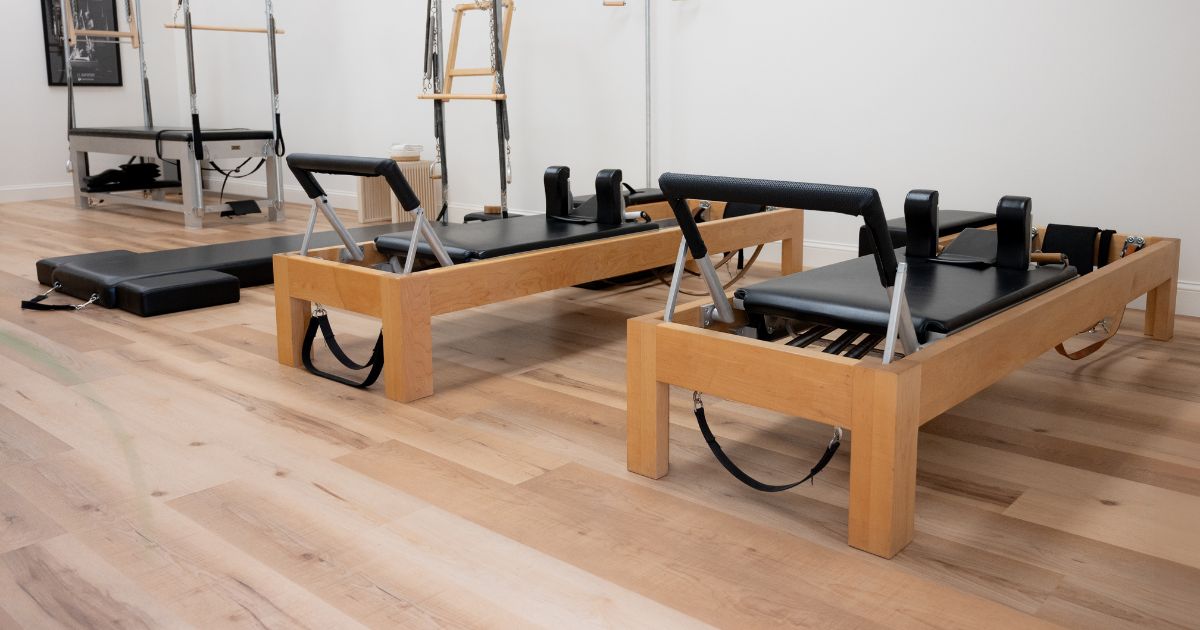
In other words: the research studied the kind of Pilates that is taught in a small, instructor-led classical studio. Not a 50-person fitness class. This distinction matters enormously when you are choosing where to practice.
What to look for in a Pilates studio if you have back pain
Drawing on both the research and what I see every week, a few things separate a studio that can genuinely help from one that may make things worse.
Look for traditional classical certification. Romana’s Pilates and PMA-certified comprehensive training programs require about 600 hours of training plus a supervised apprenticeship. A weekend “Pilates instructor” certification — and there are plenty of those out there — does not provide the depth required to work safely with someone in chronic pain.
Ask about private or duet sessions. Group classes can be appropriate once you have a stable practice, but if you are in pain right now, you need an instructor who can watch your specific movement patterns and modify in the moment. That is not possible with 12 people on reformers.
Expect an initial evaluation. A studio that puts you straight into a group class without first asking about your history, your imaging if you have any, and how you move — that studio is not set up for rehabilitation work. At Life by Pilates, every new client starts with an evaluation. I want to understand the picture before I make a plan.
Be skeptical of dramatic timelines. The research is consistent: meaningful change takes 5 to 8 weeks of twice-weekly practice — roughly 10 to 16 sessions — and the benefits compound with continued practice. A studio promising you’ll be pain-free in three sessions is selling something else.
When Pilates is not the right first step
Pilates is generally safe, but it is not a substitute for medical evaluation when red-flag symptoms are present. See a physician before starting any new exercise program if your back pain comes with any of the following:
- Pain that radiates below the knee, especially with numbness or weakness
- Loss of bladder or bowel control
- Unexplained weight loss alongside the pain
- Fever with back pain
- Pain that wakes you up at night
- A recent fall or trauma
For most adults with non-specific chronic back pain, Pilates is appropriate and helpful. For the smaller group with structural concerns, Pilates may still be the right path later — once medical evaluation has cleared the way.
Frequently asked questions
Most clients report some relief after 2 to 3 sessions. Lasting change — the kind that stays even when you take a few weeks off — typically takes 6 to 8 weeks of consistent twice-weekly practice. The research backs this up. Most positive trials measured outcomes at the 6-to-8-week mark.
The research has compared them and found similar outcomes when both are properly taught. In my experience, the Reformer has an advantage for back-pain clients in the early stages: the springs provide assistance and feedback that allow gentler, more controlled work. As clients build strength, the Reformer can also be progressed to add resistance. The mat is excellent for maintenance and home practice between sessions. In a well-equipped classical studio, you’ll work on both.
For most clients, Pilates complements rather than replaces physical therapy. I am not a licensed physical therapist, and I do not diagnose or treat injuries directly. What I do is build on the foundation a physical therapist establishes. Many of my clients come to me specifically because their PT recommended Pilates as the next step.
The research is clear: twice per week is the threshold for measurable change. Once a week maintains what you’ve built but doesn’t progress as efficiently. Three times a week accelerates results for clients who can fit it into their schedule.
If you have recent imaging (MRI, X-ray) or a physical therapy report, please bring it. I don’t need it to begin, but it helps me understand what to be cautious about. If you have an active diagnosis like a herniated disc, scoliosis, or osteoporosis, we will adapt your program accordingly.
A final word
Pilates isn’t a miracle cure. It won’t undo decades of poor movement habits in a single session, and it cannot replace medical care when medical care is what you need. But the research is clear, and what I see in the studio every week is consistent with it: when practiced properly, with a qualified instructor, twice a week, for the long term — Pilates reduces chronic back pain and the disability that comes with it. The benefits compound. The skill carries over into your daily life. And unlike most interventions, the side effects are good ones — a stronger core, better posture, and a body that moves with more freedom.
If you live in the Old Tappan area and want to talk about whether classical Pilates might help your back, reach out to schedule an initial evaluation. We’ll talk through your history, your goals, and what a realistic path forward might look like for you.
Sources referenced:
- Yu Z, et al. “Effect of pilates training on pain and disability in patients with chronic low back pain: a systematic review and meta-analysis based on randomized controlled trials.” Journal of Exercise Nutrition and Biochemistry, March 2023. PubMed
- Yu H, et al. “Efficacy of Pilates on Pain, Functional Disorders and Quality of Life in Patients with Chronic Low Back Pain: A Systematic Review and Meta-Analysis.” International Journal of Environmental Research and Public Health, 2023. PMC
- Wong CM, Rugg B, Geere JA. “The effects of Pilates exercise in comparison to other forms of exercise on pain and disability in individuals with chronic non-specific low back pain: A systematic review with meta-analysis.” Musculoskeletal Care, March 2023. PubMed
- Suh JH, et al. “Pilates to Improve Core Muscle Activation in Chronic Low Back Pain: A Systematic Review.” Healthcare, 2023. PMC