The short answer (TL;DR)
An adult scoliosis diagnosis later in life brings chronic back stiffness, muscle imbalances, and spinal compression from structural asymmetry. Clinical research confirms that targeted Pilates exercise training significantly reduces Cobb angles, decreases trunk rotation, and improves quality of life. Here is how true Classical Pilates supports your spine:
- It systematically decompresses the spine using specialized spring resistance on the Cadillac to open tight facet joints and hydrate discs.
- It builds deep stabilizing endurance in the Powerhouse to act as an active, three-dimensional internal brace against gravity.
- It addresses rotational asymmetries using unilateral exercises on the Wunda Chair to isolate and balance muscle imbalances.
An adult scoliosis diagnosis is rarely a sudden crisis. For most adults, it is a gradual realization.
It is the persistent, dull ache on one side of your lower back that never quite dissipates. It is the discovery that your favorite pair of trousers suddenly hems longer on the left leg than the right. Or perhaps it is a routine X-ray for an unrelated issue where the doctor casually points to a distinct, lateral S-curve in your spine.
In my studio, Life by Pilates, I work with clients every week who have spent years compensating for these structural asymmetries and are now seeking specialized Classical Pilates for scoliosis relief. By the time they arrive at my door in Old Tappan, they are tired of standard general fitness classes that treat their body as a symmetrical machine. They are looking for a highly personalized, precise path to move without chronic stiffness.
If you have been diagnosed with scoliosis later in life, your structural goals differ fundamentally from those of an adolescent. Your growth plates are fused. Our priority is not “straightening” the spine to a perfect zero-degree line. Instead, our goal is to build deep muscular support, decompress compressed joints, and create dynamic pelvic stability so you can live a full, active life.
The Anatomy of Asymmetry: What Adult Scoliosis Actually Is
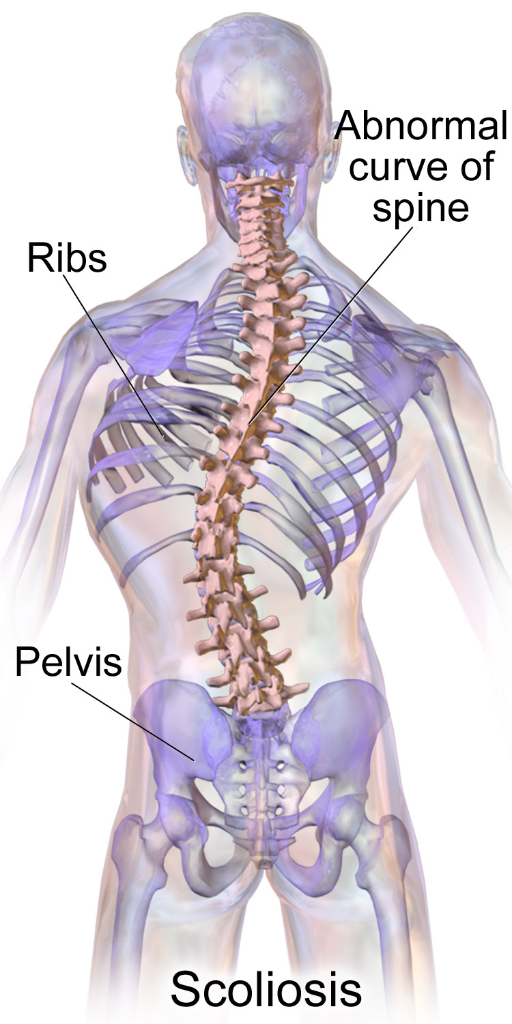
In the clinical world, structural scoliosis is defined as a lateral curvature of the spine of 10 degrees or more, measured as a Cobb angle on an X-ray. While adolescent idiopathic scoliosis (AIS) is diagnosed during puberty, adult scoliosis generally falls into two categories:
1. Adult Idiopathic Scoliosis: Spinal curvature that began in youth but went unnoticed or untreated, progressing slowly as the body aged.
2. Degenerative (De Novo) Scoliosis: Curvature that develops in adulthood due to asymmetric degeneration of the spinal discs, facet joints, and supporting ligaments.
As the discs between your vertebrae wear down unevenly, the spine begins to tilt and rotate. This creates a three-dimensional deformity. The spine does not just curve to the side; it rotates on its axis.
This structural rotation creates a distinct muscular imbalance. The muscles on the concave (compressed) side of the curve become short, hyper-toned, and stiff, locked in a perpetual state of contraction. Conversely, the muscles on the convex (lengthened) side are overstretched, weakened, and mechanically disadvantaged.
When you perform symmetrical exercises—such as standard squats or group reformer fitness routines—your body naturally defaults to its established path of least resistance. The strong side does the work; the compressed side collapses further. You do not correct the asymmetry. You reinforce it.
Red-Flag Medical Advisory
While chronic stiffness and mild asymmetric discomfort are common with adult scoliosis, certain symptoms require immediate medical intervention. If you experience sudden, severe back pain, progressive numbness or tingling in your limbs, pain that radiates down your leg (sciatica), or any loss of motor control or bowel/bladder function, see a physician immediately. These are signs of neurological compression that general conditioning cannot address.
What the Research Actually Says: Cobb Angles and Clinical Evidence
We do not rely on marketing claims. We examine peer-reviewed research.
1. The Cobb Angle and Quality of Life Deficits
A comprehensive meta-analysis of randomized controlled trials published in the journal Medicine (Baltimore) evaluated the impact of Pilates training on scoliosis patients (Yu Z, et al. Medicine (Baltimore), 2021; PMID: 34596121).
The researchers discovered that Pilates exercise training led to statistically significant reductions in both the Cobb angle and the angle of trunk rotation, while simultaneously decreasing back pain and improving overall quality of life. By strengthening the core musculature, Pilates provides the spine with an active, muscular support system that offsets the asymmetric pull of gravity.
2. The Asymmetry Deficit: Pilates vs. Schroth
However, clinical clarity requires us to distinguish general exercise from specialized protocols. In a landmark study published in the Journal of Physical Therapy Science, researchers compared standard Pilates exercises against the highly specialized Schroth method in patients with idiopathic scoliosis (Kim G, et al. Journal of Physical Therapy Science, 2016; PMID: 27134403).
Both exercise groups showed notable improvements in their Cobb angles and weight distribution after twelve weeks of training. However, the Schroth group—which utilizes highly specific, three-dimensional breathing and asymmetric corrective exercises—showed a more significant reduction in spinal curvature.
What does this tell us?
It proves that while Pilates is a powerful tool for spinal mobility and core strength, a generic Pilates routine is not enough. To safely manage structural scoliosis, your training must be highly customized, asymmetrical, and precisely tailored to your body’s specific curve.
True Classical Pilates for Scoliosis: Decompressing and Supporting the Curve
To break this cycle of pain and compensation, you must improve spinal mobility, decompress compressed joints, and build deep, lasting core endurance. True Classical Pilates, originally named Contrology by Joseph Pilates, is uniquely designed to address these exact requirements.
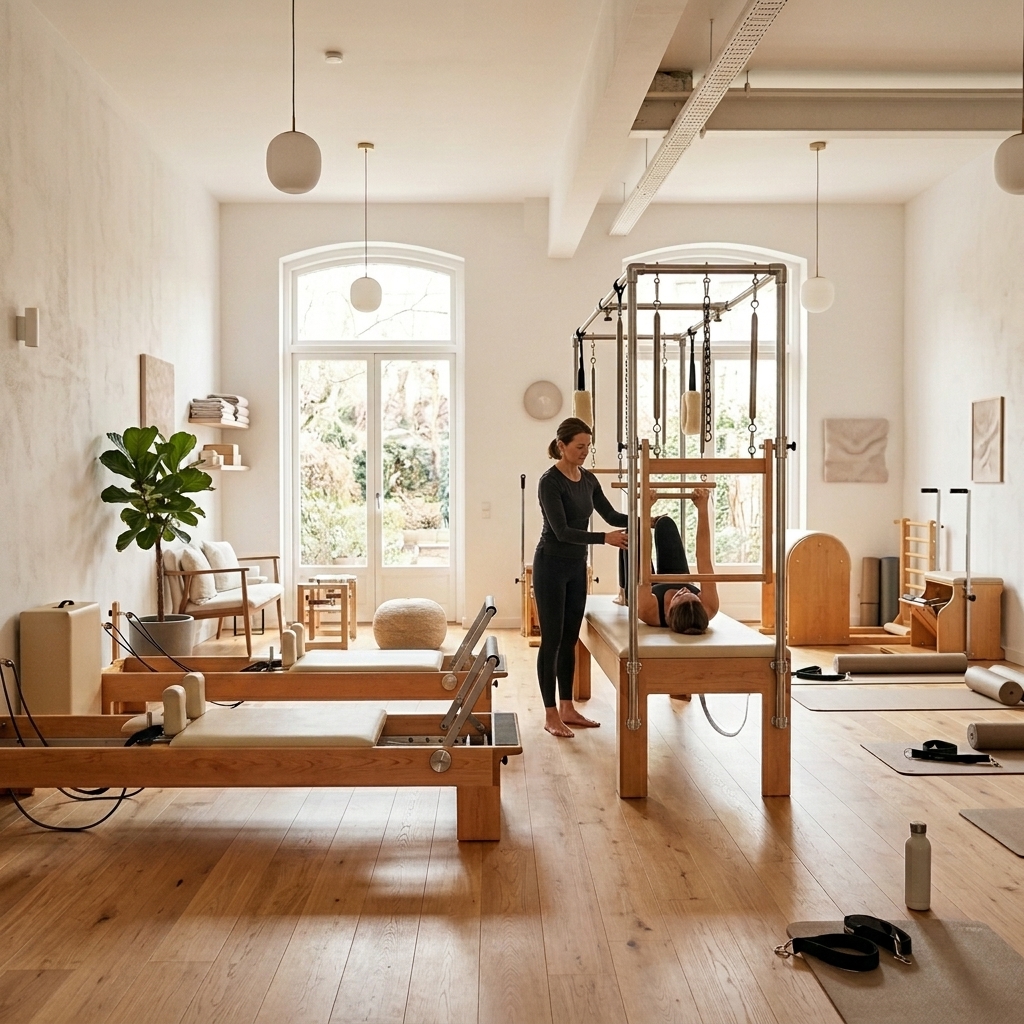
Unlike contemporary fitness trends that focus on isolated muscle fatigue or generic group training, Classical Pilates is a highly systematic method. We utilize specialized, custom-crafted apparatus—such as the Reformer, Cadillac, and Wunda Chair—to develop your Powerhouse.
The Powerhouse is the center of your body, encompassing the muscles from the base of the ribcage to the pelvic floor, including the deep stabilizers of the spine (the transversus abdominis, pelvic floor, and multifidus). When your Powerhouse is strong and active, it acts as an internal brace, absorbing the forces of gravity and protecting your skeletal alignment.
Decompressing the Cadillac
Scoliosis causes gravity to compress the spine unevenly. On the Cadillac (Trapeze Table), we utilize the heavy springs to hang or pull, creating axial traction. By gently elongating the spine, we open the compressed facet joints and give the hydrated discs space to breathe.
Exercises like the Short Spine on the Reformer or leg spring work on the Cadillac help clients experience length and decompression they cannot find standing up under the weight of gravity.
Finding Feedback on the Reformer
The Reformer is engineered with precise spring resistance. Unlike free weights, which allow your stronger side to compensate, the Reformer forces both sides of the body to push against an equal mechanical load. When you perform footwork or leg strap series, the spring tension exposes your muscular imbalances immediately, allowing us to actively cue your weaker side to engage and restore dynamic pelvic stability.
Rotational Alignment on the Wunda Chair
Because scoliosis involves spinal rotation, we must train the body to maintain structural alignment and resist twisting under load. The Wunda Chair is an exceptional tool for this.
By performing unilateral (single-sided) exercises—such as single-leg presses or lunges against spring resistance—we isolate and strengthen a collapsed hip, glute, or side-body imbalance without allowing your dominant side to compensate, actively restoring functional symmetry.
Re-Educating the Brain: Proprioception and the Powerhouse
While systematic reviews provide our scientific baseline, my daily studio experience in Bergen County reveals the human element of this training.
In my studio, I have observed that clients with scoliosis do not just report physical relief—they report a profound cognitive shift. When you live with a spinal curve, your brain’s internal map of where “straight” is becomes distorted. You feel aligned when you are actually tilted.
Through the intense mental concentration demanded by Contrology, we rebuild this proprioceptive feedback loop. By combining hands-on alignment corrections with visual cues, we teach your brain to recognize true vertical alignment. Over time, this conscious correction becomes a subconscious habit. You walk differently, sit differently, and stand taller.
Simple and Consistent: The Path Forward
Managing your spine is a daily practice, not a weekly appointment. The journey to a pain-free spine does not require hours of exhausting workouts or complex, confusing protocols. It requires consistency, precision, and a willingness to address the root cause of your limitations.
In my studio, I work one-on-one with clients to build a strong foundation. We do not rush. We do not use aggressive, jarring movements. Instead, we use the controlled, purposeful principles of Contrology to re-educate your muscles and restore balance to your joints.
You will stand taller. Your ribcage will feel open. And the spinal stiffness? Relieved.
If you are ready to stop managing spinal discomfort with temporary fixes and start building a resilient body that supports your alignment, let us begin. You can explore our session options on our rates page. Contact the studio today to schedule your private Individual Assessment and discover how true Classical Pilates can support your longevity and skeletal health.
Frequently Asked Questions
No. Structural scoliosis in adults involves fused bony changes and cannot be “cured” or reversed by exercise. However, Pilates is highly effective at managing and alleviating the secondary symptoms of scoliosis, such as chronic muscular stiffness, joint compression, and postural imbalances.
Generally, no. Large, fast-paced group reformer classes utilize standardized, symmetrical exercises that allow your dominant muscles to over-compensate. This can reinforce your asymmetrical curve patterns and increase your risk of back strain. Private or duet classical instruction is highly recommended to ensure safe, custom modifications.
To see lasting changes in your mobility and spinal endurance, I recommend practicing Classical Pilates two to three times per week. This frequency allows your nervous system to build new proprioceptive habits and maintains muscle length and core strength to support the spine under gravity.
You should avoid deep, unassisted spinal flexion (like standard heavy sit-ups) and aggressive, unmonitored twisting under heavy loads, which can place sheer forces on the apex of your spinal curve. Always work under the direct supervision of a certified classical teacher who can provide safe modifications.
If you have acute, severe pain or a recent medical diagnosis, you must obtain clearance from your physician before starting. Once cleared, a private 50-minute Individual Assessment is the safest path forward. We will evaluate your movement boundaries and construct a safe, highly tailored program.
Sources Referenced:
- Yu Z, et al. “The effect of Pilates exercise training for scoliosis on improving spinal deformity and quality of life: Meta-analysis of randomized controlled trials.” Medicine (Baltimore), October 2021. PMID: 34596121
- Kim G, HwangBo PN. “Effects of Schroth and Pilates exercises on the Cobb angle and weight distribution of patients with scoliosis.” Journal of Physical Therapy Science, March 2016. PMID: 27134403