The short answer
Pilates for tennis players is a way of fixing the parts that the court takes out of balance. At Life by Pilates, we use the Reformer, Cadillac and Wunda Chair to teach the shoulder blades to stay steady overhead, the spine to turn the same way to both sides (not just the forehand side!), and the hips to control a wide stop and push off again. It doesn’t replace your tennis coach – but it makes your body more even and balanced on and off the court.
Tennis is a one-sided sport.
You serve with one arm. You turn harder to one side. You lunge onto the same leg again and again. After a few seasons the body shows it: one shoulder sits a little lower, one hip is tighter, one side of the lower back does more of the work.
Most players I teach don’t need more of what they already do on the court. They need the other side.
That’s what Pilates for tennis players is for. At my studio I teach true Classical Pilates, the method Joseph Pilates called Contrology, in private and duet sessions only, so every program starts from your body and your game.
What does Pilates for tennis players do?
A good stroke starts at the ground. The push travels up through the feet, knees and hips, turns through the ribs, and only at the very end goes out through the shoulder, elbow and wrist.
When every part moves well, the work is shared.
When one part gets stiff, usually the hips or the upper back, something else has to work harder. If the upper back doesn’t turn, the lower back and the shoulder turn more than they should. If the shoulder blade doesn’t sit steady on the ribs, the small muscles around the shoulder and the forearm take the hit. If the outer hip gets tired in the second set, the knee starts drifting in on wide lunges.
Classical Pilates works on exactly these links. Every exercise asks you to move from your center, which Joseph Pilates called the Powerhouse, and to move evenly on both sides.
What does the research say?
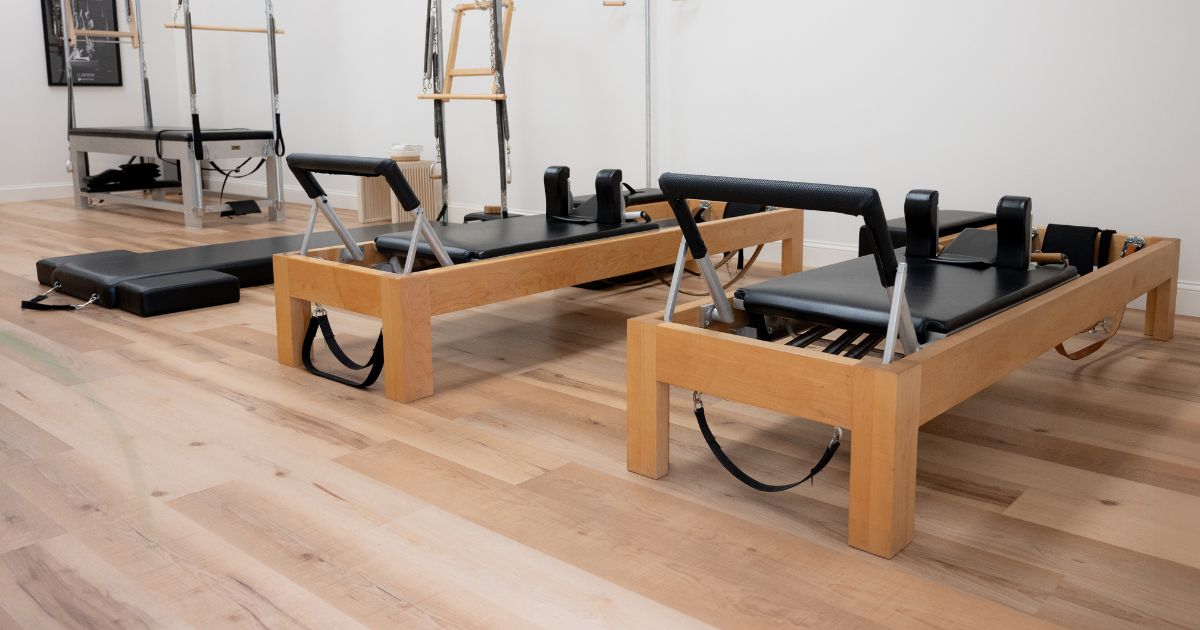
There isn’t much research on Pilates for tennis players specifically. So here is what there is, and what it actually found.
In 2025, W.L. Mun and colleagues measured the shoulder-blade muscles of 26 healthy men during Reformer arm work, with the arms at four angles: 0°, 90°, 135° and 160° (Mun WL, et al. Medicina, 2025; PMID: 40282934). As the arms went higher, the lower trapezius and serratus anterior, the muscles that hold the shoulder blade flat and steady, worked harder. The balance between the upper and lower trapezius was best at 90° and 135°.
In plain words: the angle of your arms decides which muscles do the work. For a tennis player, whose shoulder spends a lot of time overhead, that matters. The authors wrote:
“Our findings highlight the impact of the shoulder abduction angle on scapular muscle activation, suggesting that different angles may be used to engage specific muscles during Pilates reformer arm work exercises selectively.”
The other study I want to mention is about tennis elbow. In 2015, L.M. Dale and colleagues added Pilates-based core work, posture correction and flexibility to regular occupational therapy for 17 people with lateral epicondylosis (Dale LM, et al. Work, 2015; PMID: 27331240).
Both groups got better. The Pilates group improved more on the Patient-Rated Tennis Elbow Evaluation (38.1 points against 22.9), but the difference between the groups wasn’t statistically significant. It’s a very small pilot study, and the authors themselves said more research is needed.
So I won’t tell you Pilates fixes tennis elbow. What I can share is the idea the study started from, because it’s also how I teach:
“Core stability and flexibility, features of Pilates exercise, can reduce loads to the upper extremities. Reducing loads is essential to improve symptoms for individuals with lateral epicondylosis.”
When your center and your shoulder blade do their job, your elbow doesn’t have to do everything.
The 5 things we work on in Pilates for tennis players
The shoulder blade
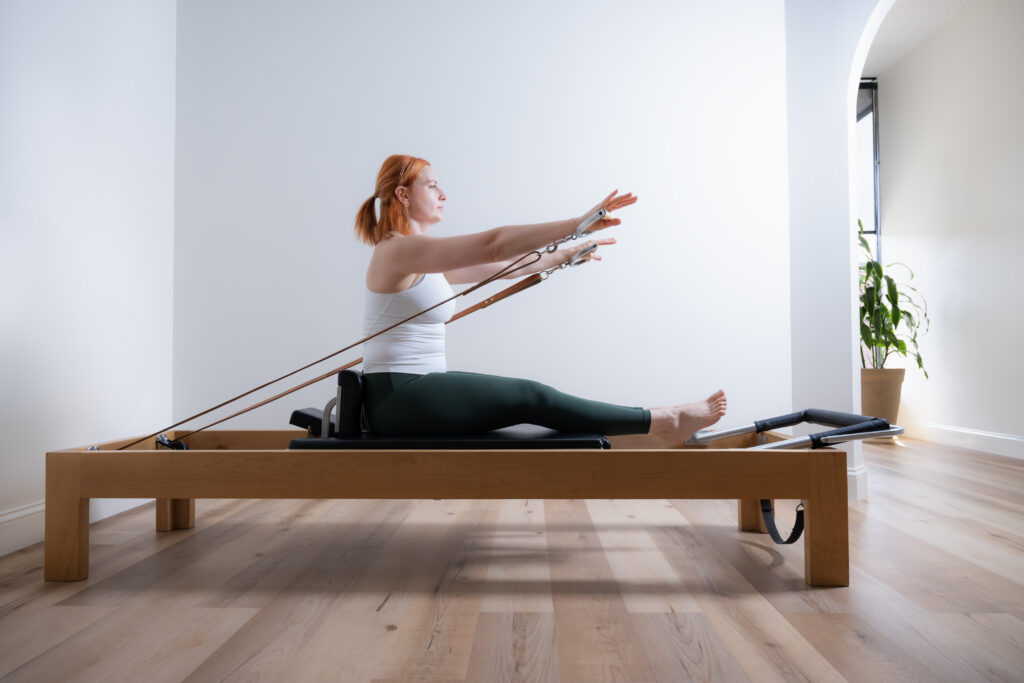
Most people try to make their shoulders strong with weights or bands. Very often the neck and upper traps end up doing the lifting.
On the Reformer and the Cadillac, in Rowing, Chest Expansion and Arm Circles, I teach you to keep the shoulder blades wide and down while the arms work, with the neck relaxed. It sounds simple. At first, it isn’t.
Turning to both sides
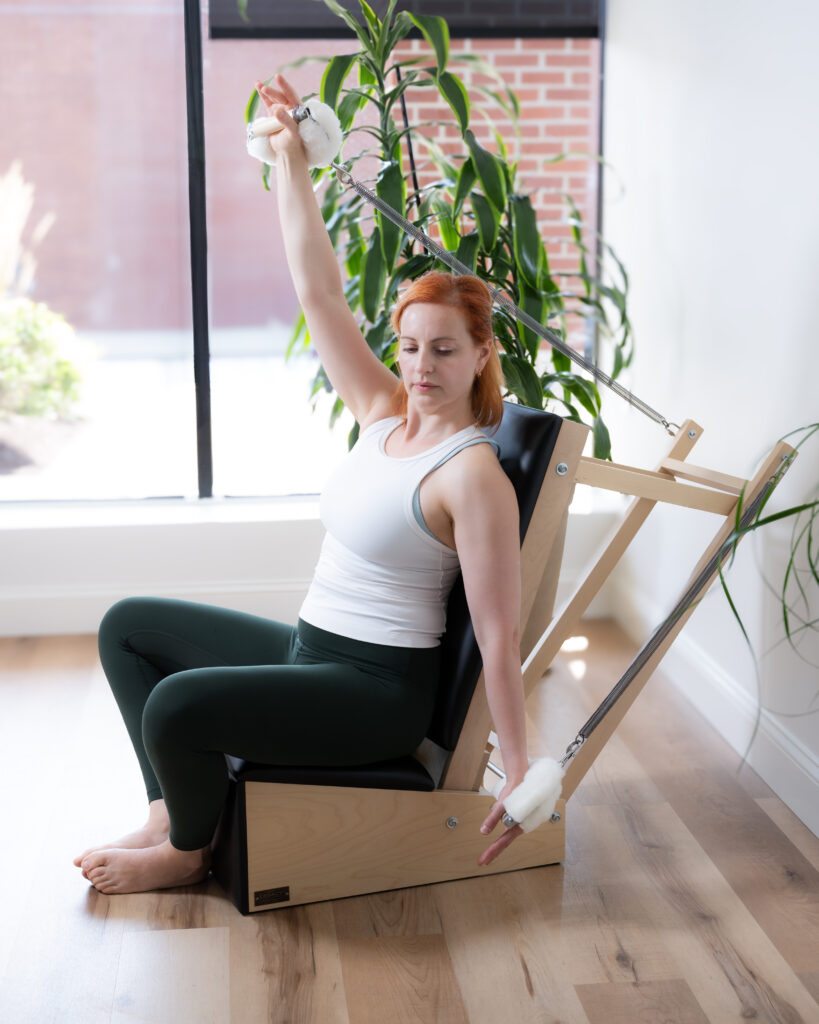
A right-handed player turns hard to the left hundreds of times a week and rarely turns that hard to the right.
In Classical Pilates every twist, like Spine Twist, Saw and the twist on the Short Box, is done evenly to both sides with the pelvis still. Because the hips can’t help, the turn has to come from the ribs and the upper back, not from the lower back.
Stopping and pushing off
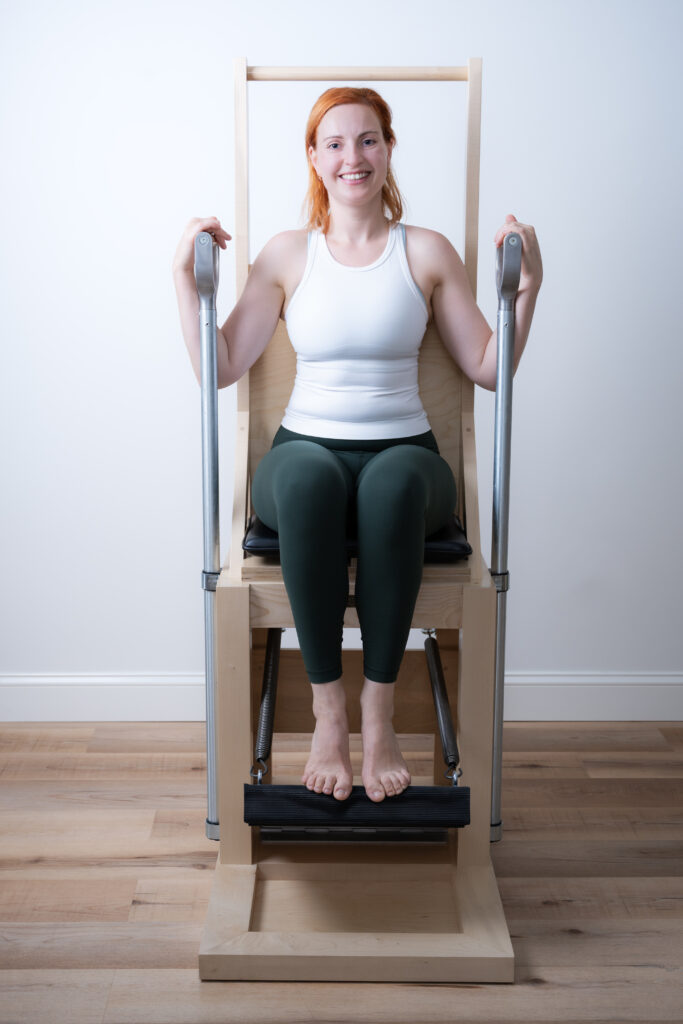
Tennis footwork is split steps, wide lunges and quick recovery to the middle.
In Side Splits on the Reformer you push the carriage out and then control it back in against the springs, standing tall. On the Wunda Chair you work on one leg at a time. Both teach the outer hips and inner thighs to control the stop, not only the push.
The back of the legs
Instead of holding a stretch on the floor, we lengthen the calves and hamstrings while they work against the springs, in Tendon Stretch, Running and Stomach Massage on the Reformer.
Holding your posture late in the match
Technique usually falls apart when you get tired. The head drops on the serve, the backhand becomes all arm, and you bend at the waist instead of the knees.
A full session asks your Powerhouse, the deep abdominals, the small muscles along the spine and the pelvic floor, to keep working for fifty minutes. That’s the kind of endurance you want in a third-set tiebreak.
When to see a doctor first
If you have sharp pain in the shoulder when you lift your arm, numbness or tingling down the arm, a known rotator cuff tear, or sudden pain in the calf or Achilles, stop playing and see an orthopedic doctor before you start anything new. Every session at my studio is private or duet, so we can work around a sensitive joint and follow what your doctor says.
Pilates for tennis players in Old Tappan
If you play a few times a week in Bergen or Rockland County, we’ll start by looking at how you rotate, how your shoulder blades move overhead and where your dominant side takes over.
You can see private and duet options on the rates page. Whenever you’re ready, reach out through the contact page and we’ll find a time.
Katya Almog is a Romana’s Pilates-certified Classical Pilates teacher and the owner of Life by Pilates, a private studio at 216 Old Tappan Rd, Old Tappan, NJ.
Frequently asked questions
If you play two to four times a week, once or twice a week is a good rhythm. Once a week helps keep the two sides of your body even. Twice a week lets us build strength and endurance without tiring your legs for the court.
Tennis elbow needs a diagnosis and a plan from your doctor or physical therapist, and Pilates doesn’t replace that. The research is still thin: a small 2015 study found that adding Pilates-based core work to therapy didn’t make a significant difference. What Pilates for tennis players can do is train your center and your shoulder blade so your whole body shares the stroke. If you’re being treated, tell me, and we’ll stay inside what your clinician recommends.
I’d keep it to days you don’t play, or after you play. A full session works the deep muscles of the spine, hips and shoulders, and you want them fresh when you serve.
Because your two sides are different. In a group class everyone gets the same springs and the same repetitions on both sides. In a private session I can see where your dominant side takes over and change the springs and the exercises for you. That’s why I teach Pilates for tennis players only privately or as a duet.
Usually not the way you do after heavy weights. Most people leave feeling taller and looser. If it’s all new to you, give yourself a day before an important match.