
Every golfer knows the feeling of a perfect drive. The crisp snap of contact, the effortless launch, and the long, straight carry down the fairway. It feels light. It feels simple.
But behind that apparent simplicity is a complex, high-velocity athletic movement. The golf swing requires your body to coil like a spring and release in a fraction of a second, producing massive rotational forces. It is an asymmetrical movement repeated dozens of times per round, always in the same direction.
Over time, this one-sided stress takes a toll. The lower back begins to ache on the drive home. The hips feel tight when you stand up from a chair. The swing begins to feel forced, stiff, and increasingly inconsistent.
Many golfers accept this discomfort as an inevitable tax of the game. They stretch their hamstrings, buy a new driver with more forgiveness, or take a few anti-inflammatory pills before heading to the first tee.
These adjustments do not solve the underlying issue. The true breakdown lies in a lack of joint mobility and muscular endurance, forcing the lower back to bear loads it was never designed to carry. To play without pain and improve your swing mechanics, you must train your body as a complete, integrated system. This is why golfers across Bergen County visit my Old Tappan studio to practice true Classical Pilates.
The short answer (TL;DR)
A powerful golf swing requires explosive, asymmetrical rotation, putting extreme mechanical stress on the lumbar spine. Clinical research confirms that lower back pain in golfers is directly tied to lead-side hip restriction and deficits in trunk rotation endurance. Here is how true Classical Pilates supports your game:
- It systematically improves internal rotation of the lead hip to prevent the pelvis from stopping prematurely during the follow-through.
- It builds deep trunk rotation endurance to protect your spine from violent mechanical forces as you fatigue on the back nine.
- It addresses one-sided muscle imbalances by restoring rotational symmetry across your entire body.
The Anatomy of the Swing: Why the Lower Back Pays the Price
To understand why golfers suffer from chronic lower back pain, we must look at the kinematic chain of the golf swing. A powerful swing does not originate in the hands or arms. It begins at the feet, transfers through the legs and hips, moves through the trunk, and finally accelerates through the arms to the club head.
Ideally, your hips and thoracic spine (upper back) provide the necessary rotation. Your lumbar spine (lower back) is structurally built for stability, allowing only about ten to fifteen degrees of total rotation.
When your hips or upper back are tight, the kinematic chain breaks down. Your body must find rotation elsewhere to complete the backswing. It forces the lumbar spine to twist far beyond its healthy anatomical limits while under extreme compressive force.
This mechanical compensation is the primary driver of golf-related back pain.
Red-Flag Symptom Advisory
While mild muscular fatigue or stiffness is common after a round of golf, certain symptoms indicate a more serious spinal issue. If you experience shooting pain down your leg (sciatica), numbness or tingling in your feet, sudden muscular weakness, or pain that worsens at night, you must consult a physician immediately. These are signs of potential disc herniation or nerve compression that require professional medical evaluation before resuming any exercise program.
What the Research Actually Says: Hips, Trunk, and Back Pain
We do not have to rely on golf course folklore to understand this connection. Peer-reviewed clinical research has mapped the exact biomechanical deficits that lead to golf injuries.
1. The Lead Hip Rotation Deficit
One of the most significant clinical findings in golf biomechanics is the link between restricted hip rotation and spinal stress. In a study published in the American Journal of Sports Medicine, lead author Dr. Vijay B. Vad and colleagues examined professional golfers to identify the physical characteristics associated with back pain (Vad VB, et al. American Journal of Sports Medicine, 2004; PMID: 14977679).
The researchers discovered a clear, statistically significant correlation: golfers with a history of lower back pain demonstrated a distinct reduction in internal rotation of the lead hip—the left hip for a right-handed golfer—compared to their pain-free peers.
When the lead hip cannot rotate internally during the downswing and follow-through, the pelvis stops prematurely. To finish the swing, the golfer must forcibly twist the lower back. This compensatory motion places massive shear forces on the lumbar discs and facet joints, leading to micro-trauma and chronic inflammation.
2. The Endurance Deficit
While golfers often focus on developing raw rotational strength to hit longer drives, clinical evidence suggests that muscular endurance is far more critical for spinal protection.
Research published in the North American Journal of Sports Physical Therapy by researchers D. Lindsay and J. Horton investigated trunk rotation strength and endurance in elite male golfers (Lindsay D, et al. North American Journal of Sports Physical Therapy, 2006; PMID: 21522218). The study demonstrated that golfers with a history of lower back pain exhibited significantly less trunk rotation endurance, particularly in the non-dominant direction, compared to healthy elite golfers.
A lack of muscular endurance means that as you reach the back nine, the deep stabilizing muscles of your spine fatigue. Without their support, your spinal joints absorb the violent rotational forces of the swing. By the fourteenth hole, your mechanics degrade, your posture collapses, and your lower back is left completely unprotected.
The Classical Pilates Solution: Restoring the Powerhouse
To break this cycle of pain and compensation, you must improve hip mobility and build deep, lasting spinal endurance. True Classical Pilates, originally named Contrology by Joseph Pilates, is uniquely designed to address these exact requirements.
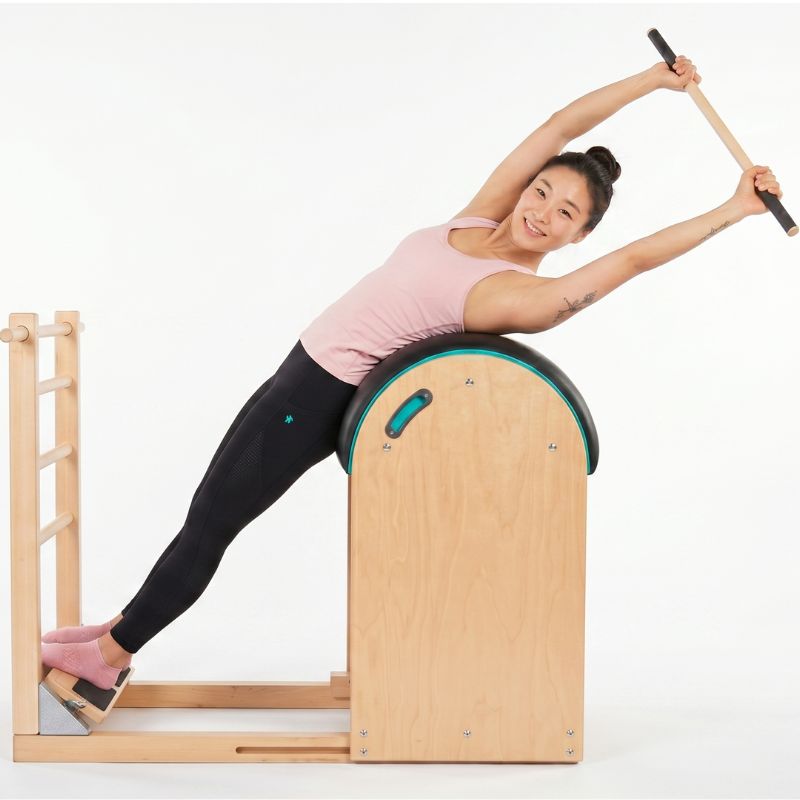
Unlike contemporary fitness trends that focus on isolated muscle fatigue or generic group training, Classical Pilates is a highly systematic method. We utilize specialized, custom-crafted apparatus—such as the Reformer, Cadillac, and Wunda Chair—to develop your Powerhouse.
The Powerhouse is the center of your body, encompassing the muscles from the base of the ribcage to the pelvic floor, including the deep stabilizers of the spine. When your Powerhouse is strong and active, it acts as a dynamic shield, absorbing the forces of the swing and protecting the lumbar spine.
Developing Hip Dissociation
In our private sessions, we focus heavily on “hip dissociation”—the ability to move the hip joint freely without co-moving the pelvis or spine.
On the Reformer, exercises like the Leg Circles and Frog in the feet-in-straps series allow us to mobilize the hip joint under the gentle, uniform resistance of steel springs. The pelvic girdle remains perfectly anchored to the carriage. This isolates the hip socket, stretching the tight deep rotators and restoring the internal rotation needed for a clean, pain-free follow-through.
Building Rotational Symmetry
Because golf is a one-sided sport, golfers develop profound muscle imbalances. One side of the torso becomes incredibly tight, while the other becomes overstretched and weak.
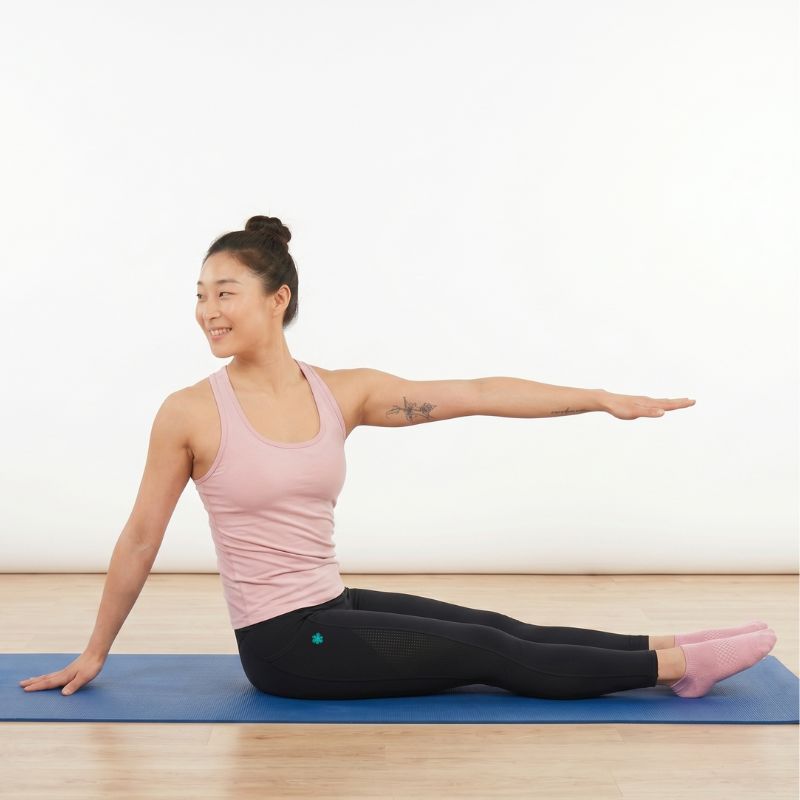
We address these imbalances through the rigorous rotational work of the Classical repertoire. On the Mat, exercises like the Spine Twist teach you to rotate the thoracic spine while keeping the pelvis stable, building deep endurance in the obliques and multifidus. Because we perform every exercise in both directions with equal focus, we gradually restore structural symmetry to your body.
Clinical Evidence: Pilates and Swing Performance
Restoring your body’s mechanics does not just prevent pain. It directly enhances your performance on the golf course.
A comprehensive study published in the Journal of Strength and Conditioning Research evaluated the impact of a targeted core and flexibility program on recreational golfers (Lephart SM, et al. Journal of Strength and Conditioning Research, 2007; PMID: 17685707).
The researchers put golfers through an eight-week training program designed to improve trunk stability, hip mobility, and shoulder flexibility. The results were striking:
- Torso rotational strength increased significantly.
- Hip range of motion improved markedly, particularly in internal rotation.
- Swing velocity (club head speed) increased by an average of 5.2%, leading to greater driving distance.
By developing a stable center and mobile hips, the golfers were able to transfer energy more efficiently from the ground up, generating more power with less physical strain. They hit the ball further, not by swinging harder with their arms, but by utilizing a more efficient, coordinated kinematic chain.
Simple and Consistent: The Path Forward
The journey to a pain-free swing does not require hours of exhausting workouts or complex, confusing protocols. It requires consistency, precision, and a willingness to address the root cause of your limitations.
In my studio, I work one-on-one with clients to build a strong foundation. We do not rush. We do not use aggressive, jarring movements. Instead, we use the controlled, purposeful principles of Contrology to re-educate your muscles and restore balance to your joints.
You will stand taller. Your hips will move more freely. And your lower back? Protected.
If you are ready to stop managing back pain with temporary fixes and start building a resilient body that supports your game, let us begin. You can learn more about our private session options and membership plans on our rates page. Contact the studio today to schedule your private Individual Assessment and discover how true Classical Pilates can support your longevity on and off the course.
Frequently Asked Questions
Yes. Stiffness is not a barrier to Pilates; it is the reason to practice it. Classical Pilates does not require pre-existing flexibility. Every exercise on the Reformer and Cadillac can be adjusted with spring tension and leather straps to accommodate your current range of motion. We work systematically to release tight muscles and open closed joints at a pace that is safe for your body.
Traditional weight training often focuses on isolating large, superficial muscles to build bulk or strength. Pilates focuses on the deep, stabilizing muscles of the Powerhouse and teaches your muscles to work together as a cohesive system. This improves your coordination, balance, and joint mobility, which translates directly to the complex, dynamic movement of the golf swing.
To see lasting changes in your mobility and spinal endurance, I recommend practicing Classical Pilates two times per week. This frequency allows your nervous system to integrate the new movement patterns and build the muscle memory required to maintain proper alignment during your swing. Consistent practice is the key to preventing injuries.
No. Pilates actually improves your swing timing by enhancing your mind-body connection and body awareness. Because you learn to initiate movement from your Powerhouse, you will develop a more consistent, repeatable swing sequence. You will find that your transition from backswing to downswing becomes smoother and more naturally coordinated.
If you have an active, acute spinal injury, you must obtain medical clearance from your physician or physical therapist before beginning any new exercise program. Once cleared, a private 50-minute Individual Assessment is the safest way to start. We will carefully evaluate your movement boundaries and construct a highly modified, safe program tailored to your recovery.
A final word
Pilates isn’t a miracle cure. It won’t undo decades of poor movement habits in a single session, and it cannot replace medical care when medical care is what you need. But the research is clear, and what I see in the studio every week is consistent with it: when practiced properly, with a qualified instructor, twice a week, for the long term — Pilates reduces chronic back pain and the disability that comes with it. The benefits compound. The skill carries over into your daily life. And unlike most interventions, the side effects are good ones — a stronger core, better posture, and a body that moves with more freedom.
If you live in the Old Tappan area and want to talk about whether classical Pilates might help your back, reach out to schedule an initial evaluation. We’ll talk through your history, your goals, and what a realistic path forward might look like for you.
Sources referenced:
- Vad VB, et al. “Low back pain in professional golfers: the role of associated hip and low back range-of-motion deficits.” American Journal of Sports Medicine, March 2004. PubMed
- Lindsay DM, Horton JF. “Trunk rotation strength and endurance in healthy normals and elite male golfers with and without low back pain.” North American Journal of Sports Physical Therapy, May 2006. PubMed
- Lephart SM, et al. “An eight-week golf-specific exercise program improves physical characteristics, swing mechanics, and golf performance in recreational golfers.” Journal of Strength and Conditioning Research, August 2007. PubMed